Showing posts with label review. Show all posts

Sunday, December 31, 2023

If Not, Winter - Fragments of Sappho translated by Anne Carson, Folio Society edition


 I’m very pleased with my purchase of this beautiful edition. The letterpress printing and cream-colored paper are simply exquisite—Homer himself might have called it “a wonder to behold.”

The aesthetic quality is especially striking when compared to the Cambridge University Press edition of Sappho, translated by Diane J. Rayor and André Lardinois. That edition, while scholarly and comprehensive, is printed on stark white paper that gives it a "print-on-demand" appearance—somewhat jarring and far less refined than this elegant hardcover.

Yet this comparison highlights a recurring dilemma I’ve encountered with historical Folio Society editions. As physical objects, they are often unmatched in beauty and craftsmanship. However, the content inside sometimes lacks scholarly rigor or up-to-date editorial standards.

In this case, the Cambridge edition contains over 100 more fragments than the Folio, making it the better choice for scholars and serious readers. Still, the Folio edition offers the original Greek text alongside the translation—a rare and valuable feature.

When it comes to the translations themselves, Rayor’s approach is careful, measured, and free from excessive embellishment. In contrast, the Folio edition features Anne Carson’s translation, whose poetic voice (with all due respect) tends to dominate. That said, Sappho’s surviving fragments have long invited imaginative interpretation, and Carson’s rendition fits squarely within that tradition.

Ultimately, each edition has its strengths: the Cambridge for accuracy and completeness; the Folio for beauty and poetic boldness. I’m grateful to have both on my shelf.

Sunday, June 5, 2022

"The Poetics" by Aristotle


"How to tell a Story, An ancient Guide to the Art of Storytelling for Writers and Readers" is nothing less than Aristotle's classic masterwork "The Poetics", translated, rearranged and introduced by Philip Freeman.

Freeman is a university professor in Malibu California ( yes, some guys just have it all ) and to reassure  his readers that he has not tinkered with the text while rearranging, the book is printed with the original Greek text on the left-hand side and the English translation on the right.

Aristotle's "Poetics" is of course THE seminal text in literary theory which cannot be absent from your library. It's a thin book with a huge content and reading it you are reminded of all these concepts and idea's which we take for granted nowadays but which were posited and explained first by the great Aristole: there is the Mimesis ( imitation ) of Auerbach's fame, the Catharsis ( purification ),  the apò mēkhanês ( Deus ex Machina ) and even the Homeric Anagnorisis ( Recognition ).

Reading the  Poetics invariably comes with this sad awareness that writings, these repositories of  narratives and knowledge, are fragile and fleeting. Throughout his book, Aristotle illustrates his literary concepts with numerous examples of texts and authors, most of which have been lost. Lost, probably forever, altough they were once written down and numerous copies existed. The Margites, a comic epic by Homer Himself for instance, gone...The Antheus by Agathon dissapeared, the Lynceus by Theodectes, lost; the Cresphontes by Euripides and the treatise "On Poets" by Aristotle forgotten...

This sad feeling culminates when the book frustratingly ends with chapter two "on Comedy" followed by white pages. The second part of the "Poetics" is lost too.

Umberto Eco, in his "In the name of the rose" fantasizes that the last copy of Aristotle's Comedy is destroyed by the fictional Jorge, the obsessive blind librarian, in a bonfire that sets the whole medieval library ablaze.

An interesting read!


Thursday, May 26, 2022

The Twilight World by Werner Herzog

It is not really surprising that one grows trust - issues after fighting 5 years of intense war.

So when Hiroo Onada, a Japanese officer on an endless guerrilla mission on the island of Lubang in the Philippines, is informed that Japan has surrendered and the conflict is over, he does not believe it and creeps even deeper in the jungle to continue the fight. For thirty more years...

Initially consisting of four soldiers, over the years the squad is reduced to a single person. One soldier surrenders in the fifties and walks out of the jungle. Two others are killed by Philippine troops trying to oust them out of the forest. Only Onada keeps eluding all tentative of contact in the decades following the end of WW2. 

Onoda will remain hidden until 21 February 1972, when Norio Suzuki, a young world-traveller, onto whom the soldier has stumbled in the forest, convinces the old man to come out of his hiding . 

His is the story told in The Twilight World, the latest book by famous cinematographer Werner Herzog. Herzog has a penchant for exceptional characters, especially so if they are hidden, lost or trapped in the jungle. Suffice to remember his movies or documentaries featuring Aguirre, Fitzcarraldo, Dieter Dengler and Juliane Koepcke. And now with his recent novel, the Twilight World, he has added to these Hiroo Onoda. 

The title of the book sounds even more dramatic in the original German: "Das Dämmern der Welt, like in the operatic word "Götterdammerung", a slow darkening, a closing out of the light, a creeping darkness preceding a full black-out. 

When on tour in Tokyo in 1997, Herzog shocks his hosts, by preferring a meeting with the jungle rescapee instead of with their Emperor. According to the German, He and Onoda, both jungle - aficionados, connect easily and have long discussions. The soldier tells his story and the 100-page novel is Herzog interpretation of it. While clearly irenic in intention, the author sides with the loner; the point of view in the narrative is the one of the warrior. The peaceful inhabitants of the island, who fear the ghost in the forest are rarely mentioned, their perspective is omitted. 

One can either mock or pity Onada for wasting away 30 years in the jungle. But the truth is more complex. Over the decades American war planes and warships kept flying over or passing the island. Unbeknownst to him, they are enroute to the next battlefields, the Korean and then the Vietnamese. Refusing to surrender, the old Japanese remains a danger for the isolated local civilians he encounters on the fringe of the jungle. And it is rather unfair from Herzog that he tells about the death of the two companions of Onada, killed in ambushes by Philippine soldiers and not about the 30 farmers the Japanese officer kills over the years, stealing their food and destroying their crops. 

As long as one of the belligerent parties decides to continue the fight, and there is always one who does, the fight continues. 

That is also Onoda's statement in a sentence that might be a blurb for a book on Human History. 

"The truth is that War is never over. Only the locations of the battlefields change"

Monday, January 31, 2022

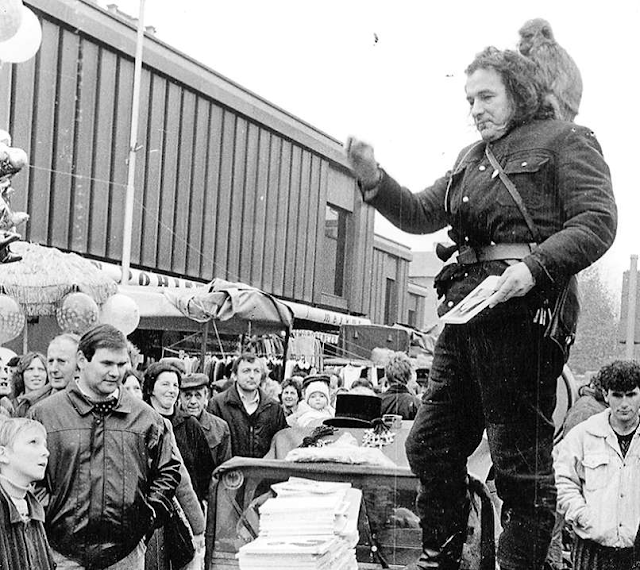
Kramberger with Monkey by Rick Harsch


picture by Natasha Juhnov

There was such a man.

Three decades ago, there was, in far-away Slovenia, a self-made businessman with presidential ambitions, orating to his fellow-citizens with a monkey on his shoulder.

He was killed. Someone shot him down, just like the Kennedy's. They caught the suspect; a drunk. Intoxicated he confessed; sober he denied. But he went to prison all the same.

And the Monkey, asks the narrator, where was it when the fatal shot rung? Did it call in sick that day ?

So begins Rick Harsch's novel "Kramberger with Monkey", a wild and runaway exploration on political murders, rogue reporters, innocent scapegoats, invisible hitmen, murdering chimps, seedy politicians, ludicrous conspiracy theories, emerging democracies and coagulating autocracies.

In 44 dazzling funny chapters, and with a handful of devilishly selected scenes ( both true and fictional ), the author reminds us of the senselessness of the human comedy played out in an indifferent world.

As always with Harsch : dark entertainment shedding light.

Sunday, January 23, 2022

"Anabasis" by Xenophon


Lately I have been reading, enjoying and schooling myself with the 2400 year old "Anabasis" written by Xenophon.

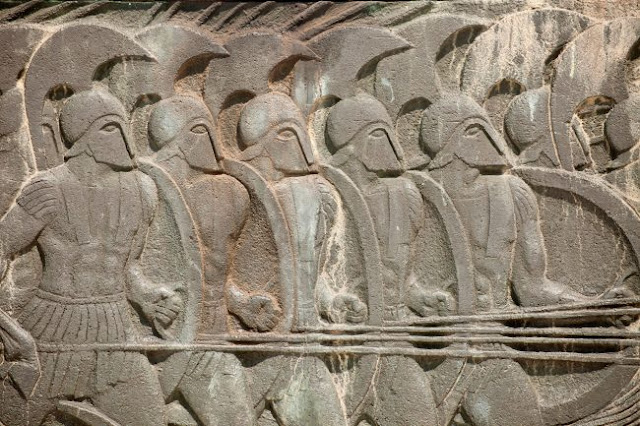
The story relates the ordeal of the 14.000 Greek mercenaries who enter the Persian Empire in 401 BCE, commissioned by the Persian prince Cyrus (the Younger), in his attempt to dethrone his older brother King Artaxerxes.

But things do not go as planned and the mercenaries get themselves stranded a few kilometers from the city of Babylon (the actual Bagdad), deep into enemy territory and with all their senior commanders dead. The troops however are feared Hoplites and the army of Artaxerxes hesitates to launch a frontal attack, even at the moment when the Greeks are at their weakest. This gives these foreign phalanxes just the few days they need to reorganize and elect new leaders.

Enters Xenophon. It is a bit unclear why this 30 year old, well-educated scion of a wealthy Athenian family, is among these fighters, but in this moment of confusion and chaos, he stands up as one of the new leaders. Their new objective: get the army of mercenaries out of Persia as fast as they can. A march of 1500 km through unknown and dangerous territory, surrounded by numerous hostile armies and tribes, awaits them.

It is no wonder that such a story still captivates the mind.

I have read Xenophon narration in the illustrious Robert Strassler's Landmark edition. This is a series of important historical texts, translated and annotated by numerous specialists in the field. Lavishly illustrated with maps, with detailed drawings of battle formations and with pictures of the actual sites, these books make a huge difference on the reading experience. If there is a proof that digital reading will never fully replace reading a paper-book, this is it.

Xenophon’s Anabasis (which basically means an "inland march") turns out to be a detailed report of the long retreat to get out of enemy territory. Its main attraction is that it is written on the level of the individual grunt; no great overarching strategic vistas. It is continuous "problem solving" on human level. Do we attack or negotiate? Do we cross the river or not? Shall we advance or wait? And this with the continuous concern to keep the vanguard and rearguard safe and the distance between them never dangerously overstretched.

Besides turning out to be a very capable and humble commander, Xenophon is also a perfect narrator. Even though he is an Athenian, he has strong and open sympathies for the Spartan lifestyle: resilience, perseverance, grit. No wonder he is banned from Athens. And he couldn't care less. Xenophon was an early student and follower of Socrates, and he was disgusted with the Athenian city for the condemnation of the famous philosopher. His Anabasis therefore can somehow be read as Socratian philosophy applied to a long survival situation.

Tough as steel in battle, proud when deserved but humble when in error.

A strong recommendation


Wednesday, November 3, 2021

Alexandria by Edmund Richardson

Remnants of an Army by Elisabeth Butler. 


Alexandria, a historical biography of amateur archeologist James Lewis, is a book I enjoyed very much for it succeeds to be interesting on multiple levels. 

First of all, it is captivating read, at moments even a page - turner, with its many narrative surprises, fascinating characters and cliff-hanger-ending-chapters.
Edmund Richardson brings us a deeply researched biography of a James Lewis  (1800–1853) a.k.a Charles Masson, a soldier with the British East India Company, who in 1827 deserts the Army and walks, on foot and with a single companion into the Thar desert in search of the mythical city known as "Alexandria under the Mountain". It is also known as "Alexandria in the Caucasus", a fabulous city created by Alexander himself.
This is the beginning of  narrative worthy of all  the best fictions you ever read. I will not divulge what Masson uncovers in his digs in Afghanistan, but he is the hero of the book and a few pieces he uncovers are still prized artifacts in the British museum.


Alexandria is also the kind of book that leaves the reader, more clever with the ways of the world, after turning the final page. There is the "Great Game" Geo-political for instance, the political climate in which Masson travels, does his research, his diggings and his discoveries. There is the increased meddling of the British into Afghan politics, culminating into the first Afghan - Anglo war. A conflict launched by a British invasion and legitimated by "fake news" ( The Russians meddling in Afghan politics ).  On a more human level, there is the race and the competition for fame and wealth of a handful of adventurers and amateur archeologists. They fiercely grub in the Afghan soil searching for lost cities, treasures, gold and gems. It is a no-holds-barred fight and one cringes at the destructive methods that are used to uncover ancient tombs and price-less pieces of art.  Kipling was inspired by these ruffians for his story "The Man who would be King". All of this is thoroughly researched. The notes at the end of the book total nearly 60 pages for a novel of 260 pages.

Finally, there is a post-modernist tang to this history book, in the sense that it skeptically and ironically reframes what we learned at school, the so-called common knowledge,  the history we were brought up with.

Alexander the great ? Not always so great after reading this book, but what a convenient historical figure  for 19th century politicians who endorse conquest "to bring civilization".

There  was no hard frontier between east and west. The border towns, cities, civilizations merged the best of east and west and were therefore wealthy and striving. Afghanistan was Buddhist before the Arabs conquered the country. The destruction of the irreplaceable Buddha statues of the Bamiyan valley in March 2001, was just "mopping up", a last chapter in eradicating the remnants of a non Islamic culture.

Avarice, plunder and political opportunism will bring you further than mere intellectual curiosity. The famous Archeologists Schliemann and Evans were in fact destroyers and looters.
And men like Richardson are doomed to be forgotten.

Some British officers behaved like savages in Afghanistan and  Pakistan. You are not likely to forget the civilizing works of Lieutenant Loveday.

In the end, the bullies win most of the time; the meek lose most of the time.

An excellent read.

Sunday, January 31, 2021

Ray Bradbury : "The Martian Chronicles"


My first reaction when turning the pages of the "Martian Chronicles" was, that even after a lifetime of reading, classic fiction can still surprise, entertain and even delight the most blasé of readers. Now nearly three quarters of a century old, we must acknowledge that Ray Bradbury’s "Chronicles" have aged surprisingly well. The book is certainly as enjoyable, jolting and actual today, as it was when its chapters first appeared in the Planet- and Wonder stories magazines shortly after the War.

 
A firmly established Classic since long, the book might even have improved over the years. The time elapsed since publication has added a certain hue of innocent boyhood-charm to the pages, albeit darkened with a strange patina of nostalgia and dismay.
 
Published in 1951, a mere 6 years after the Earth blasted into the Atomic Age and a decade before our first hesitating flea hops into outer space, the novel has lost nothing of its urgency. It raises concerns indeed over values and doings that still worry us today:  Racial oppression and exploitation, genocide and colonization, nuclear war and militarism and even planetary pandemics. Some chapters, with recent occurrences in mind, have the emotional impact of a Biblical text.
 
I read that “the chronicles” was a book readers liked to "carry with them over a lifetime." And I can easily understand this. Somehow these chapters stick and keep ghosting in the reader’s mind. Bradbury understood this attraction because the "Chronicles", rather than a work of science fiction, had the allures of a myth or a fable.
 
With only 305 pages and 26 short chapters the “Chronicles” invite easy reading. Even more so because each chapter is a short-story, very loosely related to the previous or the next. One can dip into any chapter without need to have an overall comprehension or an overview of a storyline. The Martian Chronicles are in fact what is called a fix-up, a novel created by combining several unrelated short-stories. Some short interstitial chapters, frame stories and a bit of editing here and there have done the magic of organizing it all into a composite novel.
 
The lesser effort in reading allows more time for pondering over the stories told.
The general story - line is clear: a sequence of Mankind's efforts to land on, explore, understand and colonize the planet Mars. That the colonization of Mars echoes chapters of the colonization on Earth is of course intentioned. Parallels can easily be detected within our history - books, from the Pilgrim Fathers to the Indian Wars, from Jim Crow laws to Hiroshima.
 
But when meeting the Martians in the future, unbiased by our nationalities, free from our history, our culture and our skin color, and strengthened this time by our Scientific and Historical knowledge, will Man act differently this time?
 

Friday, September 11, 2020

Topaze by Marcel Pagnol


Fernandel as Topaze
“It is exactly like the story of my mother's chimpanzee. When she bought, him he was skinny, he stank of misery, but I have never seen such a loving monkey. We gave him coconuts, we fed him bananas, he became as strong as a Turk, he slapped the maid. We had to call the fire department ... "

It was this funny quote, remembered by my dear father, that brought Topaze, this hundred-year old theatre piece written by Marcel Pagnol to my attention. Pagnol is of course no stranger for whoever has benefitted from an education at a French “college”. Especially his biographical novels, like La Gloire de mon père, Le château de ma mère and le temp des secrets were recommended novels for generations of young readers. Pagnol, a member of the French academy, was very famous in his time, not only as a writer, but also as a scenarist and moviemaker. 

Topaze was written in 1928 and an immediate and lasting success as soon as it hit the stage. Even today, the play is very entertaining and has barely aged. It tells the story of Topaze, a naïve and gentle teacher working in a school in a Paris suburb. Everybody, we soon notice, fellow teachers and pupils alike take advantage of this gentle person. Topaz in his unworldly simple-mindedness is unfit for the foul and corrupt world of the big city. When he refuses to falsify the school results of a rich dunce and he has a misunderstanding with the daughter of the school director, he is kicked out without any ado.

The unfortunate Topaze however is not long without a job. One of the students’ mother has noticed the childlike innocence and naivety of the teacher and decides to present him to her lover, a corrupt politician. Involved in many questionable business enterprises, this unscrupulous wheeler-dealer is in search of a straw man to shield himself from too much public attention. Topaze just fits the profile and is hired on the spot. His salary is doubled, his attire gets a make-over and his new business card mentions ‘Director’.

But the shrewd politician might have underestimated Topaz. Because this excellent teacher turns out to be a fast learner too…

An entertaining and funny read. 

Sunday, August 23, 2020

A.N. Wilson : Dante in Love

Gustave Doré, the ninth circle of hell, 1861

A recent newspaper article reminded me of the English writer-biographer A.N. Wilson. His name was not unfamiliar, so I looked him up in my library and yes, I had one of his books on my stacks: “Dante in Love”. It is a nice - looking illustrated hardcover, first edition and it seems that I purchased or received it immediately after its publication, in 2011. As I did not remember to have read it from front to back, I must have probably just dipped in, got bored and shelved it away. I gave it a 2 and 1/2 stars’ appreciation on LT. Not very generous and not fair, as I now understand after a second reading. 

For there was a second reading. While leafing through it, I got captivated and read it again, this time from the first to the last page. Finishing books nowadays, is in my case already a pretty sure sign of quality. As I grow older, I get impatient with books. 

Dante in Love is in fact a huge gloss on Dante Alighieri masterpiece Commedia. In his book, a long narrative poem, now rechristened as the ‘Divine Commedy’, Dante describes his wandering through the Catholic sceneries of afterlife - Hell, Purgatory, Paradise. He is not walking alone, he has guides who walk by his side: Virgil, Beatrice and (surprisingly nowadays) Bernard de Clairvaux. During his journey, Dante meets and interacts with people he once knew (personally or from reputation) and who are now trapped in one of the stages of the afterlife. The end of his journey and his book brings him in the blinding and blessing light of the Lord himself. 

It is generally agreed that Dante’s Commedia is a masterpiece; just like the paintings of Giotto or Cimabue are masterpieces. As Dante judges indirectly all the people he knew by positioning them in different parts of the afterlife, his Commedy is in fact a window on the mentality, the thoughts and the reasoning’s of the Medieval and Christian world. Unfortunately, with each generation that passes, the comprehension of what exactly is written down and how we are to understand it all fades away. Dante’s Commedia’s original was a manuscript, it was written and finished between 1308 and 1320. Books and printing did not even exist back then. 

Because it is so old, and because our understanding of the world Dante describes fades away, we need books as the one Wilson wrote. A detailed, step by step recreation of Dante’s life and the world in which he lived.  The Florence, Rome and Venice of Dante are not yet the cities we now recognize, not even from old paintings. Artists did not do realistic paintings of cities in the time of the Commedia. The countries Italy, Germany and France hardly exist, their borders constantly changing. Cities are dominant and the cities are brutally ruled and mismanaged by families. The mob and the bully rule. The worldview is impregnated by the church and by a dream of an imperial Christian Europe. But neither the Church nor the Christian Emperor have full control and rebellions and heresies flare up at any moment. When the Pope resists Philips the Fair, the King of France sends a handful of thugs to the Papal palace for an iron - fisted slap in the face. 

Wilson describes it all with enthusiasm. He has been reading and studying the Commedia all his life and he now shares generously all his acquired knowledge. With him, we follow Dante’s life-path, his rise and fall, his banishment from Florence, his wanderings, his meetings, his doings, his…Loves. For there is Beatrice too, that beautiful girl Dante first sees at the age of eleven and whose platonic love will still charm readers seven hundred years later. 

Not all chapters captivated me fully along the pages, but I really enjoyed the rereading this time and I have corrected my initial appreciation to four stars. 

An interesting and good read. 

Saturday, May 23, 2020

The Snow Leopard by Peter Matthiessen


Far away eastward, far below, the Marsa River opens out into Lake Phewa, near Pokhara, which glints in the sunset of the foothills. There are no roads west of Pokhara, which is the last outpost of the modern world; in one day’s walk, we are a century away.

After a few aborted attempts to read Peter Matthiessen’s’ most popular ‘The Snow Leopard’, the lock-down gave me at last the time and space needed to join the famous author-adventurer-conservationist on his trek into the thin air of the Tibetan mountain-range.

In the last months of 1973, Matthiessen teamed up with the legendary naturalist George Schaller for a trip to the Dolpa region in western Nepal. The reason for the expedition was that Schaller wanted to study the Bharal, the Himalayan Blue sheep. His intention was to find out if the animal was more a goat than a sheep. Or if it was someting different altogether, a proto-sheep or a proto-goat, a common ancestor to both. The lama (Spiritual Master) of the Shey gompa (monastery) had in the past, and in his capra-philic wisdom, protected these beautiful animals. The result was that the Bharal were still very abundant in the wider area around the Gompa. And this in turn attracted wolves and even the elusive and therefore mythical snow leopard.

While the study of the sheepish goats would not offer sufficient attraction to an adventurer, such as Matthiessen, the long walk in fact offered many more excitements. The hope of glimpsing the Snow Leopard, this near mythic beast, was reason enough for the entire journey. But, even if that was very unlikely, the journey would still unwind along such wonders as the Blue Lake, the Saldang, the Crystal mountain and the Shey Phoksundo. For Matthiessen, a keen student of Zen, it would also allow him to practice his new acquired knowledge in the very environment where Buddhism had its cradle. It would even allow him to personally meet a famous Lama. Matthiessen from the start understood that he had embarked on a true pilgrimage, a journey of the heart.

The book ‘The Snow Leopard' recounts, in the form of a realistic travelling journal (with dates, maps and all), the long walk, Peter Matthiessen undertook, towards the Tibetan monastery hidden high up in the Himalayan Mountain range. It is a faithful recollection of the three-month tour, a genuine expedition with Sherpa’s, carriers, yaks and all. The long trek, in a snowy, cold and unforgiving mountainous area has its hidden and not so hidden dangers. The travelers are mentally and physically challenged to the extreme and find themselves more than once on the brink of life threatening situations. But the book is more than just a description of an arduous trek. Matthiessen elegantly mixes the journal entries of the expedition’s progress with digressions on what preoccupies his mind and lyrical descriptions of a sublime nature.

The long and lonely walks on the interminable paths leading around and finally up the mountain liberate the mind for long bouts of introspections. Mentally, Matthiessen was not in the best of shapes for such a trip. Feelings of guilt, sadness and uselessness seep into his mind as he grows tired and encounters more and more obstacles on his way. Confronted with the overwhelming sublime vistas of the mountain range, emotions wash over him and bring him to tears. A year earlier Matthiessen lost his second wife to cancer. Memories of her last days grieve him and feelings of guilt of leaving his orphaned children behind constantly besiege him. Like anyone who has chosen to live an independent life, it comes at the cost of doubts and remorse.

Matthiessen who is a Zen apprentice, constantly switches, whenever possible, to his concentration, introspection and Shikantaza exercises. He commits his feelings and doings unadorned to the pages and from all this honest introspection and self-explaining rambling appears a real man of life and blood. And maybe it is all a bit too honest. The narrator at times comes over as arrogant, egotistical and impatient with the ways of the locals. He is aware of it though and writes down how he regrets it. Matthiessen can never entirely shed his American-Ivy League upbringings. He likes to indulge in the ways of the locals but when confronted with their dangerous or unhealthy lives he turns away in a reflex of self-protection. In the preparation of his earlier book, Far Tortuga, he joined a crew of fisherman but when he experiences their true living conditions, he bails out without finishing the voyage. In the Snow Leopard, on his way back, he constantly outdistances his travelling companions (who carry his stuff) in an impatient grumbling pace. At each camp-fire he then regrets his attitude. One cannot but compare it to Eric Newby’s attitude to the locals in the Hindu Kush. How more humane, with its mix of mock-attitude and self-depreciation.

Matthiessen, an ecologist, is mostly interested in nature and wildlife around him. The writer has but a mere descriptive eye for the man-made wonders he sees; when he visits for example the age-old monastery lost between the peaks of the mountain range...

Then he (The Lama) enters the little prayer room that looks out over the snows through its bright blue window. On the walls of the prayer room hang two fine thangkas, or cloth paintings, and the altar wall has figures in both brass and bronze of Karma-pa, the founder of this subsect, (…). On both sides are shelves of ancient scrolls, or ‘books’, as well as thangkas (the old thangkas on the wall are in poor repair, and these rolled-up ones must be even more decrepit). The walls all around are crowded with frescoes and religious paintings, and each corner is cluttered with old treasures, all but lost in musty darkness.


It is a pity. One can only regret that Robert Byron, Chatwin or Norman Douglas are not around to elaborate further and illuminate us with their comments on the architecture of the impressive shey’s and the significance of the old thangkas displayed in the decrepit vaults of the ancient monasteries and anchoretic dungeons.

Matthiessen regularly interrupts the narration of his progress, to tell us about his experimentations with hallucinogens, the story of Siddhartha, how Asian cosmology compares with the findings of ‘modern’ physics and so on. Together with the Kathmandu scenery (his second visit) the book is basically a wrap-up of all the subjects an entire generation of hippy youth gobbled up in the last ten years preceding this book. Rather than giving the book a generous and nostalgic gloss fifty years later, one must conclude that the Snow Leopard, despite its scope, has not aged very well on all levels. At times, it is a bit boring. I suspect the Snow Leopard is one of those cult books that, in the words of journalist H. Anderson, lost their Cool’.

Matthiessen belongs to that post-war generation of writers - adventurers - discoverers who through their books, and to finance their lifestyle, contributed to open a pristine world to a larger public. They are then surprised and lament that the vanguard of encroaching commercial tribes and their reader-adepts following in their wake have destroyed the very wonders they described. They then turn into fierce environmentalist and defenders of the local communities and set-up half efficient organizations to protect what is been destroyed. Alas, all is business. And the Shey Phoksundo National Park, so magisterially described, is no exception. The internet shows that we now can book Snow leopard tours and Matthiessen tours to follow on the steps of the famous writer. Rafting those wild rivers is an option and bungee jumping over the Bhote Koshi River is a must. Matthiessen's son has lately reenacted with his father erstwhile companion Schaller, the trip all over again; walking in his dad's steps. His introduction contributes to the marketing of the Folio society’s beautiful edition of The Snow Leopard, including Schaller's original pictures. Images that are scandalously missing in my first signed edition.

As said Matthiessen is most entertaining when he describes wildlife around him. The shape of the valleys and mountains create natural amphitheater that allows a wide theatrical overview of the surrounding valleys and mounts. Matthiessen and Schaller can follow a flock of Bharal’s chased by a pack of wolves and cheer when an animal is caught or escapes by daring jumps. Schaller confesses that he has never been able to follow so well an entire chase in his long career.

We suspect that the writer is motivated by more than mere scientific interest, when he describes the kinky rutting behavior of the sporting blue sheep: male mounting male, dipping their snouts in the urine streams of the females. Both Matthiessen and Schaller exult whenever there is another ‘beautiful’ penis - lick.

There are a few true nuggets of amused wonder to be found among the 340 pages of the book.

The Nepal government takes yeti seriously, and there is a strict law against killing them. But one of the Arun Valley scientists has a permit to collect one of these creatures, and I asked him what he would do if, one fine morning, a yeti presented itself within fair range; it seemed to me that this decision should not wait for the event. The biologist was unsettled by the question; he had not made this hard decision, or if he had, was not at peace with it.

Cut away a few of the introspective ramblings 
in Matthiessen book and you are left with a wonderfully narrated voyage in the most sublime environments this planet can show. Fortunately for the reader, the overwhelming beauty abounds in 'The Snow Leopard’. The descriptions of the beautiful vistas, the gorgeous natural phenomenon’s and the animal sightings take the overhand from the introspective brooding in the second part of the book. The writing is beautiful too. Matthiessen’s Zen stuff works like John Ruskin’s ‘drawing advice’; to make one stop the time and take in the details’. Matthiessens spiritual exercises help him to 'see the world more clearly and to live with a deeper sense of presence. This and the wonderful trip he does (and of which we are a bit jealous) remains the major attraction of the book. It is not likely to disappear soon.

The trail follows the south bank of the Ghustang, a wild torrent off the Dhaulagiri glacier that cascades down over the rust-colored boulders through a forest of great evergreens, merging farther to the west with the Uttar Ganga and the lower Bheri. Where bamboo appears, four thousand feet below our Dhaulagiri camp, a log bridge crosses the torrent and a trail climbs an open, grassy slope of stolid oaks and lithe wild olives that dance in the silver breeze of the afternoon.

Sunday, October 6, 2019

The Manifold Destiny of Eddie Vegas by Rick Harsch


I've had the pleasure to be an early reader of Rick Harsch's latest novel "The manifold destiny of Eddie Vegas”. It is an exceptionally well written and entertaining book with a theme that will certainly unsettle the Reader with its terrible truths.

While “The Manifold Destiny” is written for the experienced reader of sophisticate taste, Rick Harsch, devoid of the usual authorial arrogance, respects and is kind to his audience. Even if his book is written in an elaborate language and artfully crafted sentences there is always sufficient “story" to pique your curiosity and enough entertaining things unfolding on the pages to keep you reading all along the 700 pages. That and the manageable length of each chapter is a relief from the doorstoppers which seem to be so fashionable nowadays! Unlike the Gaddises, the Wallaces and other Don Dellilo behemoths, Harsch's works come in an acceptable and digestible word - count format. 

In the "Manifold Destiny" two storylines develop parallel to each other. Both narrative arcs are separated by a few hundred years but merge towards each other as the narration reaches the end. One storyline develops in the present and follows two young men on their peregrinations between Europe and the USA, with the occasional flash-back to recent history: Vietnam, Iraq, Afghanistan. Both men wrestle with father - issues at the same time their fathers struggle with their own toxic legacy.

The second storyline describes the adventures of the earlier forefathers of the main character, each of them a witness of, and a minor player in those bygone periods of heroic Americana myth: The Mountain Men, the Oregon trail, the Gold rush, the Indian wars, the Boot-legging...

Harsch debunks these historical and heroically chunks of Americana by reminding the reader that what drives these “heroic times” is nothing more than opportunism, greed, violence, racism, genocide and a continent-wide ecocide. The chapters playing out in the "present time" (Afghanistan, Iraq and Vietnam) do not need to be demythologized as they are remembered in our collective memory as violent moments causing enormous damages to indigenous populations. Still, here too, Harsch digs up lesser known horrific facts to avoid any possible tendency to describe war as heroic: Psychological warfare in Vietnam, Commercial competition of the private military militias in the Iraq, war crimes in Afghanistan and the blind terror of the all-seeing drones.

Harsch is at times funny, sad, angry or serious, but the total world view resulting from all this is bleak. The characters seem to move around on the whim and without clear goals. As already made clear in the witty title of the book, man’s destiny, (if destiny there is), or multiple destinies are largely dependent on the roll of the dice or the shuffle of the cards. 

The metaphor of poker, or gambling in general, is seeping through all chapters.  That one finds himself in an uncomfortable situation is often caused by a random chain of events.
"Fucking Keno" is after all the memorable first and damning opening sentence.

The feature of this novel, most likely to delight even the most blasé reader, is Rick Harsch exciting writing. Harsch is a true word - wizard, a sentence - crafter of rare talent. Cunningly and with a permanent twinkle in the eye he hand-picks words, kneads them to his liking and assemble them in elaborate phrases. His recounting of the history of the American West, using a vast array of highly sophisticated narrative technique has something highly eclectic and comic at the same time. Imagine James Joyce rephrasing the stories of Fennimore Cooper, De Lillo editing the action scenes written by Sebastian Junger or Gaddis correcting Raymond Chandler. Understandably, it is not an easy book, it is after all aimed at the more experienced readers.  Any confidence with the literary techniques of American Pomo or Modernism will help appreciate the skills deployed in the novel. Reading notes are the “rigeur" for those who intend to fully enjoy the read. 

And a great read it is. Harsch shows he is really a Master of the Word. At key moments of the novel, Harsch stops assembling sentences and offers the reader only words. Words in a series of lists; multiple page long lists of seemingly random words, you are likely to skim to proceed for further impatient reading. But these lists, which should be read attentively, preferably viva voce as in a religious litany, contain more than the eye first notices. 

The last list, when it’s terrible secret dawns on you, will certainly shock you.

Rick Harsch has with his "Manifold destiny of Eddy Vegas” written a Masterpiece and as far as I am concerned, as good a candidate for the “Great American Novel” as any other more celebrated book.

You might argue that Harsch is lesser known than his best-selling peers.

That’s my point: 

So was Melville in his days.

Highly recommended !

Monday, September 2, 2019

Lenz by Georg Büchner


In my earlier Danton review I already praised Georg Büchner’s masterful precocity. Deceased at 24, he still managed to write three and a half masterpieces: Dantons Tod, Leonce und Lena, Woyzeck and the unfinished Lenz. The works are considered landmarks in the history of German literature, early precursors of the Modern European roman. They were praised by Zweig, set to music by Alban Berg and burned on celluloid by no one less than Herzog.

I found an older copy of Lenz on the second-hand book market and without hesitation took it home for a quick read. And quick it was! Only 35 pages, but so fast-paced, so modern, so obsessively written that it leaves the reader panting: the story of Jacob Lenz (1751-1792), poet and theater-maker, one of the key representatives of the Sturm und Drang, slipping into insanity. 

Poor Jakob Lenz, delicate and small, the flipside of the Goethe persona, as good a writer as the famous “Wandrer” was, maybe even better, but lacking the stature, the charisma, the social intelligence and the romantic skills. When Lenz became insufferable and a danger to Goethe’s reputation and position, the Master got rid of him. Lenz was banned from the province after a mysterious incident, an unforgivable “foolishness” that happened on the 26 of November 1776.

Büchner’s novel make us follow the interdicted Lenz; his erratic wandering, his despair, his hopeless seeking of solace, his battling bouts of depression, his final tumble into a terrifying madness from which there is no return…

What a nightmare…

Thursday, May 2, 2019

Pedro Paramo by Juan Rulfo


Legend has it that Marquez enjoyed Juan Rulfo’s book so much that on opening it for the first time, he read it twice without interruption. So did I, but simply for the reason that after the first reading I had no clue as to what it was all about. The second reading fortunately helped. As did the many blogs and webpages that offer a walkthru to the lazy reader. 

While the story, once you get it, is rather straightforward (as far as a Latin-American novel can ever be straightforward), the complexity is caused by a chopped - up and craftily rearranged narrative. A man has promised his dying mother to travel to Colima, her native village in the Mexican backcountry, and ask his and her due from Pedro Paramo, his natural father whom he has never seen.

Once there however, Colima, remembered as an agreeable agricultural community, appears to have turned into a dusty ghost town. And Pedro Paramo has been dead since many years. But the young man, who gets more and more uncomfortable in this abandoned pueblo, is not alone. Colima is haunted by numerous ghosts, who whisper and mumble snippets of the legend of Pedro Paramo to the worried traveler. Hence the complex structure of 68 parts, because the story does not develop chronologically but by the weird order of ghostly apparitions and narratives. 

The landowner - bully, Pedro Paramo, a Papa Karamazov kind of guy, turns out to be not only the reason of the downfall of Colima but also the malediction of its many ghosts. 

As for a recommendation, I can confirm that the novel Pedro Paramo is a bargain. The mere digestion of 140 or so pages of limpid prose, short and easy sections, surprising characters, an original setting and an introduction to Hacienda Horror, will give you bragging rights on having read one of the finest writers from Latin America. And this according to many sources. 

Susan Sontag even compared the quality of the storytelling in Pedro Paramo to Roth’s Radetzky March or von Kleist’s’ Kohlhaas . 

I wouldn’t go that far but you cannot be cheated on this one.

A great read.

Wednesday, October 3, 2018

the Ink Trade by Anthony Burgess


Reviewing the reviews of Anthony Burgess

For those whose idea of sheer bliss is reading literary reviews in their favourite newspaper on a rainy Sunday afternoon, (maybe followed by an invigorating nap curled up on the sofa), this book helps you to conjure exactly that pleasant feeling again and again.

The Ink trade is a collection of sixty excellent literary reviews published between 1961 and 1993 in numerous journals and papers. Reviews of those very novels that excited us in the last decades of the previous millennia and on top of that written by Anthony Burgess, pen-man “par excellence”, a peer reviewer so to say, for he was both writer and a prolific reviewer at the same time. His reviews are understandably different than those by academics like Davenport, Kenner or Kermode.

Burgess is the man who is famous for his “..clockwork Orange", infamous for the opening line in his "Earthly Powers” and enormous for his entertaining biographical dyptique "Little Wilson ..." and "You’ve had your time". He is a brillant writer, clever, witty and with a sharpened quill.

I've always had a special affection for Burgess. With his “Here Comes Everybody” and his "shorter and edited Finnagans Wake”, it was he who “explained” Joyce and Eliot to me, at a young age where neither my secondary school teachers nor my reading experience could have helped me.

Reading reviews of books already read, reminds us of the joy we experienced when reading them for the first time, when we were 30 or so years younger. But it is titillating to compare our own weak riminiscences with Burgess take on the same book. He discusses Burroughs’ Naked Lunch for instance, Desolation Angels by Kerouac, Lowry’s Volcano, Nabokov’s nymphe, Hemingway’s cojones and Eco’s rose. There is also ( Noblesse oblige ) a lot on Eliot’s Waste land and Joyce’s Dublinaria.

In some cases Burgess reminds us of books we might have passed by, forgotten or totally misssed. In my case Evelyn Waugh for instance, whose titles I hurriedly jotted down, a bit ashamed I must confess.

The format of the review makes this collection an easy reading, freeing time for the thinking and the enjoying. For enjoying is what it is all about. Burgess famously was a brillant word craftsman. Working like a goldsmith he embelishes his text with exquisite handpicked words, looping filigreed sentences and shiny marvels of expressions.


Some people take antidepressants to chase anxiety away. I read a Burgess review and have sweet dreams.